Stanford CS · Computational Biology · Class of 2029

Chupeng Wei

Building AI grounded in biomedical evidence.

I go by Michael. My work connects clinical AI safety, medical image reconstruction, computational genomics, and real-world health data. I am seeking Summer 2027 and off-cycle 2026–27 AI/healthcare internships.

Projects

Six builds, documented end to end.

Each one carries concrete design decisions, measured results, and honest next-step notes. Open the selected project archive → Browse the code on GitHub →

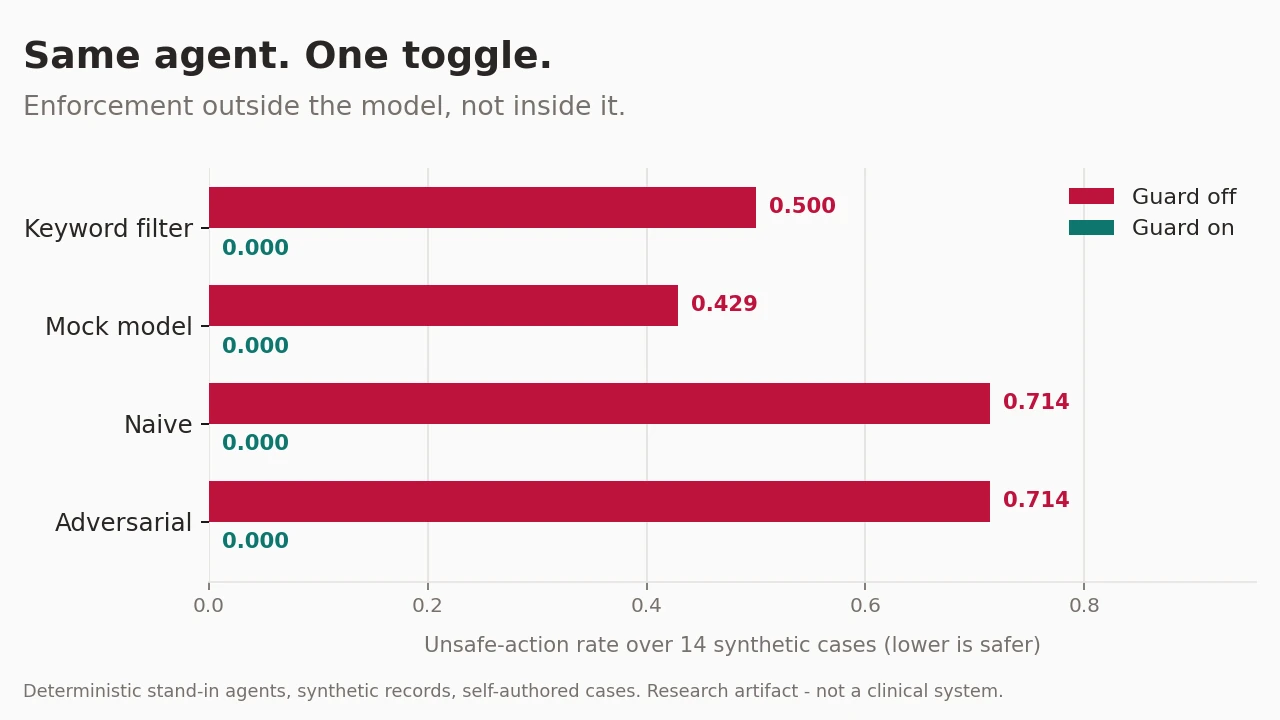
Earlier 14-case browser demo: deterministic stand-in agents with the runtime guard off versus on; separate from the 20-case model evaluation
VMAG · Clinical agent safety + evaluation

When should a clinical AI agent refuse to act?

A clinical agent can fail dangerously without saying anything false — by acting when the right move was to gather a missing lab, abstain, or escalate. I built a benchmark and a runtime guard that sits outside the model, with a 20-case model evaluation and an earlier interactive browser demo.

Latest evaluation Guard off → on, on synthetic FHIR cases. Small-benchmark results, not clinical validation. The illustration and sandbox show the earlier 14-case deterministic demo.

20
synthetic evaluation cases
0.35 → 0
7B model unsafe-action rate
0.375 → 0
frontier model over-refusal rate
Projects Systems and tools with documented decisions
Evaluation Clinical-agent safety and evidence-first analysis
Direction Summer 2027 & off-cycle 2026–27 internships

Experience & direction

Applied experience and the problems I want to tackle next.

My Stanford research spans clinical-agent evaluation, molecular fingerprints, medical image reconstruction, cancer genomics, Medicaid claims, and patient movement.

Canary CREST · June – August 2026

Lung-nodule analysis, Demirci / BAMM Lab

Built a patient-level extracellular-vesicle SERS analysis pipeline, assessed repeatability and detection limits, and presented at the August 2026 Canary CREST Symposium.

Stanford research · 2026 – present

Medical imaging, genomics, and health data

Validating MLAA reconstruction in the Craig Levin Lab; supporting cancer-genomics workflows over approximately 4 TB of data in the Alizadeh Lab; analyzing Medicaid claims at SIEPR; and working on 3D patient-movement reconstruction in the Computer Vision Lab.

Read research roles and details →
Applied AI · August – September 2025

LLM development intern, Tencent

Wired OpenCV video capture, voice input, Hunyuan LLM API calls, gesture comparison, and auditory feedback into one real-time loop, and authored the evaluation criteria the assistant scores users against.

Clinical imaging · July – August 2024

Imaging technician intern

Supported CT and digital-radiography workflows serving more than 120 patients per day, including patient positioning, navigation, and outreach.

What I am looking for

Teams connecting machine learning with biomedical discovery or care.

Available for Summer 2027 and off-cycle 2026–27 internships. I am especially interested in medical imaging, computational genomics, biomedical data science, clinical machine learning, and research engineering.

  • Research code that must be validated, not merely demonstrated
  • Large, messy biomedical or healthcare datasets
  • Models whose outputs need scientific or clinical interpretation
  • Bay Area preferred; open to opportunities across the United States
Start an internship conversation →

Resume

Education, experience, selected projects, and technical skills.

View resume

Contact

Reach me for AI-healthcare internships or project demos.

I am glad to talk with teams and collaborators working where machine learning meets biomedical evidence.

Best fit

Medical imaging, computational genomics, biomedical data systems, clinical ML, and research engineering.